Our celebration of National Dessert Month has been surprisingly chocolate-free, so we're aiming to correct that today with recipes from Chocolate and Cocoa Recipes, published around 1922. Instead of boring candy bars, we at The Devil's Tale want our plastic pumpkins filled with Devil's Food cake!
Devil's Food
2 cups sugar
3/4 cup butter
4 ounces Baker's Premium No. 1 Chocolate
4 eggs (3 may be used)
2 1/4 cups flour
4 1/2 teaspoons baking powder
1/4 teaspoon salt
1 1/2 teaspoons cinnamon
1/4 teaspoon clove
1 1/4 cups milk
Cream butter and add sugar gradually, while beating to a cream; add chocolate, melted, and beaten yolks and mix thoroughly. Sift together flour, salt, cinnamon, clove and baking powder and add to butter mixture, alternately with the milk. At the last, fold in the stiffly beaten egg whites and bake in a deep pan and ice when cold.
And, just because you can never have too many chocolate recipes (and because there were no pictures of the Devil's Food cake):
Chocolate Jelly
1 pint boiling water
Pinch salt
1 square Baker's Premium No. 1 Chocolate
2 tablespoons gelatine
1/3 cup sugar
1 teaspoon vanilla
Put the water, salt and chocolate in a saucepan. Cook, stirring until the chocolate melts, then let it boil for three or five minutes. Soften the gelatine in a little cold water and pour the boiling mixture over it. Stir until disolved, then add sugar and vanilla. Pour into a mould and set aside to harden, serve with cream and powdered sugar or sweetened whipped cream.
Our blog has moved!
You should be automatically redirected in 6 seconds.
If not, visit
http://blogs.library.duke.edu/dukelibrariesrbmscl/
and update your bookmarks.
Friday, October 29, 2010
Devil's Food
Labels:
From Our Collections,
holidays,
Just for Fun,
recipes
Wednesday, October 27, 2010
RBMSCL Travel Grants: $$$ to Visit Us!
![]() |
| Photo by Mark Zupan. |
The Sallie Bingham Center for Women’s History and Culture, the John Hope Franklin Research Center for African and African American History and Culture, and the John W. Hartman Center for Sales, Advertising & Marketing History will award up to $1,000 per recipient to fund travel and other expenses related to visiting the RBMSCL. The grants are open to undergraduate and graduate students, faculty, independent scholars, artists, and activists living outside a 100-mile radius from Durham, NC with research projects that would benefit from access to the centers’ collections.
More details—and the grant application—may be found on our grants website. Applications must be postmarked or e-mailed no later than 5:00 PM EST on January 31, 2011. Recipients will be announced in March 2011.
We're also excited to announce that the RBMSCL will be offering three new grants this year for scholars interested in using our German Studies and Judaica collections. Additional information about applying for one of these three grants will be available on our grants website soon. These new grants will have a later deadline.
Labels:
Bingham Center,
Do Your Research,
Franklin Research Center,
Hartman Center,
News and Features,
Rare Books,
Travel Grants
Monday, October 25, 2010
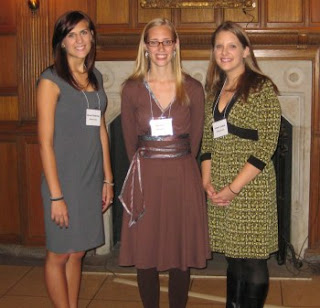
Congratulations to the 2010 Middlesworth Award Winners!
On Friday, the RBMSCL celebrated with students and parents at one of our favorite events of the year: the Middlesworth Award and Durden Prize Reception.
Given annually, the Middlesworth Awards recognize the authors of the best undergraduate and graduate student papers based on research in the collections of the RBMSCL. Funding for the awards has been generously provided by Chester P. Middlesworth (A.B., 1949) of Statesville, NC.
Undergraduate student winner Adrienne R. Niederriter plumbed the depths of the Hartman Center's Ad*Access image database for her paper, "Speak Softly and Carry a Lipstick: Government Influence on Female Sexuality through Cosmetics during World War II."
Undergraduate student winner Hannah C. Craddock received her award for her senior honors thesis, "'A New Self-Respect and a New Consciousness of Power': White Nurses, Black Soldiers, and the Danger of World War I.” Craddock's study focused upon the Ann Henshaw Gardiner Papers and the Samuel Loomis Hypes Papers.
Graduate student winner Bonnie Scott's paper began at the heart of Duke's West Campus, as she compared sermons preached in the Duke Chapel to those preached by North Carolina minister Kenneth M. Johnson during the Civil Rights Movement.
Their papers will now become part of the RBMSCL's collections.
We know that great papers are being researched and written this semester as well. If you are a Duke student, submit your paper and we might be toasting you next fall! Details about submitting your paper can be found here.
Given annually, the Middlesworth Awards recognize the authors of the best undergraduate and graduate student papers based on research in the collections of the RBMSCL. Funding for the awards has been generously provided by Chester P. Middlesworth (A.B., 1949) of Statesville, NC.
![]() |
| 2010 Middlesworth Award winners Adrienne Niederriter, Bonnie Scott, and Hannah Craddock. |
Undergraduate student winner Hannah C. Craddock received her award for her senior honors thesis, "'A New Self-Respect and a New Consciousness of Power': White Nurses, Black Soldiers, and the Danger of World War I.” Craddock's study focused upon the Ann Henshaw Gardiner Papers and the Samuel Loomis Hypes Papers.
Graduate student winner Bonnie Scott's paper began at the heart of Duke's West Campus, as she compared sermons preached in the Duke Chapel to those preached by North Carolina minister Kenneth M. Johnson during the Civil Rights Movement.
Their papers will now become part of the RBMSCL's collections.
We know that great papers are being researched and written this semester as well. If you are a Duke student, submit your paper and we might be toasting you next fall! Details about submitting your paper can be found here.
Labels:
Do Your Research,
Events,
News and Features,
students
Rights! Camera! Action!: Brother Towns
Date: Monday, 1 November 2010
Time: 7:00 PM
Location: Carolina Theatre
Contact Information: Patrick Stawski, 919-660-5823 or patrick.stawski(at)duke.edu, or Kirston Johnson, 919-681-7963 or kirston.johnson(at)duke.edu
Brother Towns / Pueblos Hermanos (59 min.) is a story of two towns linked by immigration, family, and work: Jacaltenango, Guatemala, a highland Maya town, and Jupiter, Florida, a coastal resort town where many Jacaltecos have settled. The docunmentary film chronicles how and why people migrate across borders, how people make and remake their communities when they travel thousands of miles from home, and how people maintain families despite their travel. To learn more, visit the film's website.
This screening is part of the Latin American Film Festival sponsored by the Consortium in Latin American and Caribbean Studies at UNC-Chapel Hill and Duke University, the Center for Documentary Studies, and the Carolina Theater and will be followed by a panel discussion (panelists TBD).
The Rights! Camera! Action! film series, which is sponsored by the Archive for Human Rights, the Archive of Documentary Arts, the Duke Human Rights Center, the Franklin Humanities Institute, and Screen/Society at Duke's Arts of the Moving Image Program, features documentaries on human rights themes that were award winners at the annual Full Frame Documentary Film Festival. The films are archived at the RBMSCL, where they form part of a rich and expanding collection of human rights materials.
Friday, October 22, 2010
Not Even Covered in Chocolate Sauce
Wonders never quite cease at the RBMSCL. If ever there were a foodstuff that we strongly believed should not be associated with dessert, it was cauliflower. And then we discovered The Dessert Book: A Complete Manual from the Best American and Foreign Authorities with General Economical Recipes (written by a Boston Lady in 1872). So, in honor of National Dessert Month, we present:
Meringues in the Form of Cauliflowers
Fill a biscuit-forcer with Italian meringue-paste, and push this out upon bands of paper, in knobs, or large dots, superposed or mounted one upon the other in such form or fashion, that, when complete, it shall represent, as nearly as possible, the head, or white part, of a cauliflower (of course, on a very diminished scale, of the size of a pigeon's egg, for instance): this pat of the cauliflower, when fashioned, is to be sprinkled over with rather coarse granite sugar. The under part, or green leaves, which envelop a cauliflower, are imitated in a somewhat similar manner to the above by pushing out the paste in pointed dots upon bands of paper, in the manner and form as directed for the imitation of the heads, only somewhat flatter: these, in order the better to represent green leaves, are to be sprinkled over with green granite sugar; and when both parts have been dried in the closet, or screen, stick the head, or white part, upon the leafy or green part; thus you will form more or less truthful imitation of a cauliflower, according as in a greater or lesser degree you may have displayed your taste.
Should you want to make these for your next dinner party—imagine the aghast looks on your guests' faces!—you'll find the recipe for Italian Meringues after the jump.
Meringues in the Form of Cauliflowers
![]() |
| Not dessert. |
Should you want to make these for your next dinner party—imagine the aghast looks on your guests' faces!—you'll find the recipe for Italian Meringues after the jump.
Subscribe to:
Posts (Atom)